Breakage is not bad luck. It is a packaging decision made months before the container was loaded, and it can be designed out.
Where the breakage actually happens
Most buyers assume the damage occurs when a pallet is dropped. In practice, dropped pallets are rare and three quieter failures cause almost all losses:
- Bottle against bottle, inside the carton. Every kilometre of road vibration is a small impact. Bottles that touch transfer that energy into each other for eighteen days.
- Stacking pressure on the bottom layer. A 40-foot container stacks cartons two to three pallets high. The bottom carton carries the whole column.
- Load shift at sea. A container rolls several degrees in heavy weather. Anything not restrained moves, and glass that moves arrives chipped.
Failure one: bottle-to-bottle contact
This is the single largest cause, and it is the cheapest to fix. Three levels of protection exist, and the price difference between them is small compared with the loss:
- Shrink wrap per row. Holds bottles upright and stops them falling over, but does nothing to stop glass touching glass.
- Corrugated dividers (partitions). One cell per bottle. This is the export default for anything fragile and the minimum acceptable spec for perfume and dropper bottles.
- Moulded pulp or foam inserts. Used for heavy wall, wide-shoulder or coated bottles where the decoration must not be marked. Costs more, weighs more, and is the right answer for high-value coated goods.
A carton that arrives with bottles wrapped in a single bag and nothing else was packed for domestic delivery, not for a sea container. Ask for the packaging spec in writing before you book freight.
Failure two: stacking pressure
Corrugated board is rated, and the rating matters more than the number of layers. A five-layer carton made from weak paper is worse than a well-made three-layer one. The two figures to ask for:
- ECT (Edge Crush Test, kN/m) — resistance to stacking force. This is the one that matters for a container.
- Burst strength (kPa) — resistance to puncture and handling.
Two things quietly destroy the rated strength. First, humidity: board loses roughly half its stacking strength at high relative humidity, which is exactly the condition inside a container on a tropical route. Second, printing and die-cutting: a large printed panel or a hand-hole reduces strength at that point.
Failure three: container movement
Cartons that fit the container tightly with no gap are safer than cartons that leave space. Where there is space, it must be filled — air bags, inflatable dunnage, or timber bracing against the container wall. This is the freight forwarder's responsibility, but the shipper has to authorise it, and it costs money. Confirm in writing that dunnage is included in the quote.
Palletised or floor loaded: the trade-off nobody explains
There are two ways to fill a container, and the cheaper one is the riskier one.
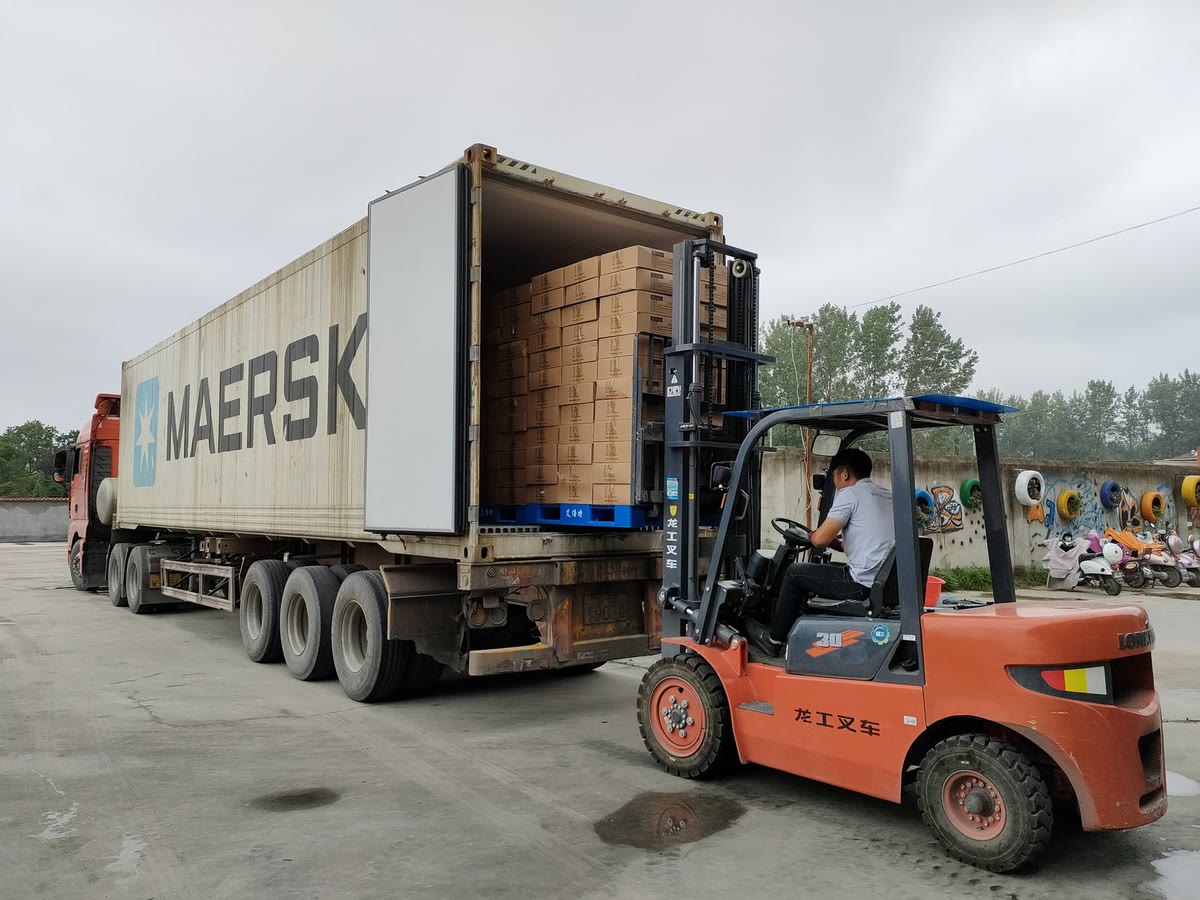
- Palletised. Cartons are stacked on standard pallets and the pallets are loaded with a forklift. Loading is fast, unloading is fast, and the load is stable because each column is bound by stretch film. The cost is space: the pallets themselves and the gaps around them consume volume, so you ship slightly less per container.
- Floor loaded (loose). Cartons are hand-stacked from the container floor to the roof. This fits roughly ten to fifteen percent more cartons in the same box, which shows up directly as a lower freight cost per piece. It also means cartons at the bottom carry a taller column, and it means unloading is manual, which at some ports is slow and at others is charged by the hour.
For glass, the default should be palletised. The extra freight is usually smaller than the value of the breakage that floor loading invites, particularly on a route where the container will be handled more than once. If a supplier quotes floor loading to win on freight, ask what the carton rating is and who is unloading it.
Who pays when it breaks
This is where the argument starts, and the answer depends entirely on the Incoterm you agreed:
| Term | Risk passes | Practical consequence |
|---|---|---|
| FOB | When goods are on board at the port of loading | Damage after loading is the buyer's risk. Buy marine cargo cover yourself. |
| CIF | Same point, but seller insures | The seller arranges cover, but the minimum required is ICC(C) — the narrowest cover, which excludes many handling losses. Ask which clause. |
| CFR | Same point, no insurance | Freight paid, risk with the buyer, no cover unless you buy it. |
Under every term, a claim needs evidence. Without a survey report and photographs taken at the point of unstuffing, an insurer will treat the loss as pre-shipment damage and decline it.
The damage that is not breakage
A carton can arrive with every bottle intact and still be unsaleable. Decoration fails differently from glass, and it is usually found later, which makes it harder to claim:
- Coating scuffing. Spray-coated and frosted bottles rub against each other and against the carton wall. The damage shows as a white bloom at the widest point of the shoulder — exactly where a buyer looks first.
- Hot foil wear. Foil lifts at the edges after repeated vibration. It looks like a printing fault and is often argued as one.
- Label shift. Adhesive labels applied in humid conditions migrate in a hot container, leaving a crooked label that reads as poor quality control.
The fix is the same one that prevents breakage — a divider cell per bottle plus an inner bag — which is why coated orders should never share a carton spec with clear glass. If your order carries a coating, say so when the packing is specified, not after the samples arrive.
How to audit a delivery in the first hour

The clock on a claim starts when the container is opened. Do these five things before the goods leave the port area:
- Photograph the container before unstuffing. Doors, seal number, and any visible shift of the load.
- Count cartons, not bottles. Compare against the packing list. Carton-count discrepancies are a separate claim from breakage.
- Weigh three cartons at random. A carton below spec weight is a carton with broken glass inside.
- Open three cartons and count. Photograph the breakage in place before removing anything — a pile of shards on the floor proves nothing.
- Look for oil staining on the outside of cartons. Staining means a bottle leaked rather than broke, which points at the closure, not the packing.
What to write into the purchase order
Four clauses turn a complaint into a contractual right:
- A breakage tolerance stated as a percentage of pieces, agreed in advance. Anything above it is replaced or credited.
- The packaging spec as an annex — divider type, board rating, cartons per pallet, pallet wrap. Not a description in the email body; an annex.
- Photos of the packed carton before loading, as a condition of shipment.
- Who pays for dunnage, and whether it is inside the freight quote.
The short version
Glass arrives intact when three things are true: nothing touches, nothing is crushed, and nothing moves. Each of those is a line item, and each costs less than the loss it prevents. If a quote looks unusually cheap on freight, ask what the carton and dunnage spec is — that is usually where the difference was taken out.
Browse the perfume bottle and dropper bottle ranges with their carton specifications listed per model, or read how we inspect and pack before a container is sealed.